
Bio-materiale
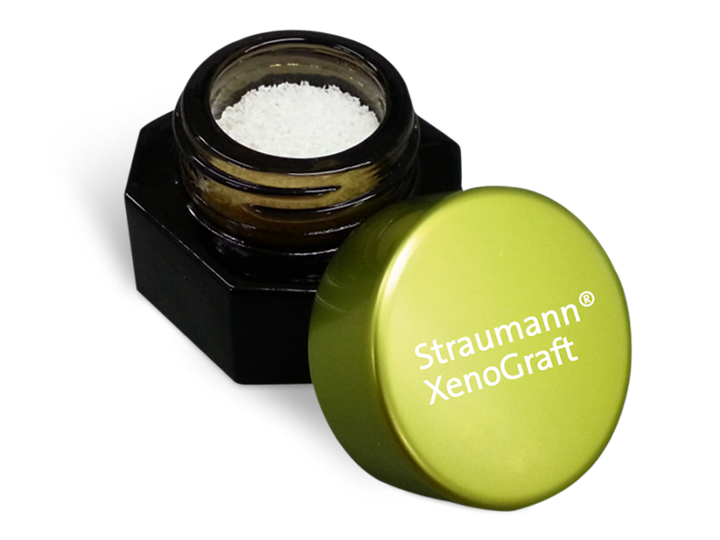
Straumann® XenoGraft
Mastering everyday cases.
Non-sintered granules
The everyday choice for successful bone and tissue regeneration.
Straumann® XenoGraft:
 Easy to handle
Long-term volume stability
Successfully applied in over 500,000 cases worldwide
Features and benefits:
Osteoconductivity – The natural structure of Straumann® XenoGraft with interconnected porous granules facilitates the adhesion and invasion of bone forming cells and results in complete integration of the implant due to the ingrowth of cells and blood vessels.
Healing environment and volume stability – Straumann® XenoGraft undergoes superficial resorption only. The granules provide excellence space maintenance and predictably integrate into newly formed bone ensuring volume maintenance and a strong long lasting matrix for successful placement of dental implants.
In order to assure maximum safety, organic components are completely removed by solvent and temperature treatment (> 500 °C) during the manufacturing process of Straumann® Xenograft. Favorable handling and performance are ensured due to the comparably low temperature treatment (non-sintered), which preserves the natural microstructure of natural bone. The final sterility of Straumann® XenoGraft is ensured by gamma irradiation.
Spongy consistency after hydration – Straumann® XenoGraft particles absorb liquid quickly and adhere to each other after mixing.
Easy handling and application – Straumann® XenoGraft particles stick to the spatula after hydration. Avoid condensation of the particles during application. Non compacted particles leave space for blood vessel ingrowth and formation of new bone matrix.
Jason® membrane
Mastering performance.
Pericardium membrane
The Jason® membrane is a native collagen membrane obtained from porcine pericardium, developed and manufactured for dental tissue regeneration. The advantageous biomechanical and biological properties of the natural pericardium are preserved during the production process.
Features and benefits:
Native collagen structure preserved during the production process
High tensile strength due to the biomechanical properties of the pericardium. Allows a wide range of fixation methods, including pinning and suturing, despite the low thickness of only ~ 0.15 mm.
Slow degradation time due to the natural honeycomb-like and multi-layered collagen structure with an increased content of collagen type III
The resulting prolonged barrier function makes the membrane the recommended choice particularly for large augmentative procedures.
Low thickness of only 0.15 mm Facilitates soft tissue manipulation, particularly in challenging thin biotypes.
Easy handling and application Can be cut to shape and size in dry or wet conditions. Does not stick to itself and to instruments. Can be easily repositioned, if needed. Exceptional adaptability to surface contour after rehydration.
